
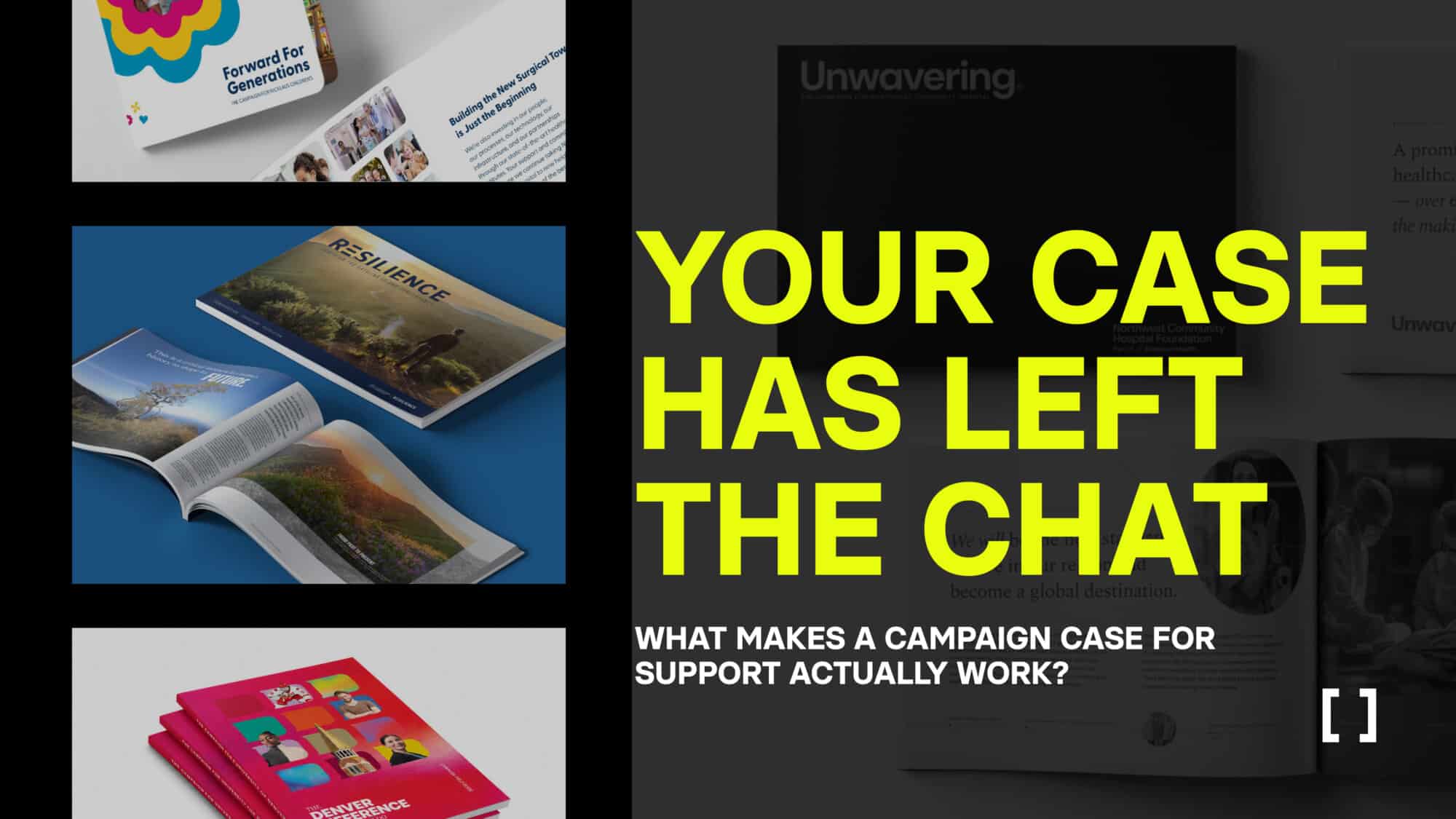
Stop me if this sounds familiar: You have a Case for Support that is beautifully written and beautifully designed. Unfortunately, as a gift officer, a relationship manager, or a campaign volunteer, you still don’t know how to use it in the conversations it was supposed to support.
This happens when a Case is treated as a finished deliverable rather than a working campaign tool. It might explain the organization well. It might clearly state the campaign priorities. But if fundraisers can’t use it, if donors don’t see themselves in it, or if the story doesn’t match the actual fundraising moment, the Case loses its purpose. It ends up collecting dust on a shelf.
The strongest Cases are built around the campaign’s real needs: the audience, the moment, the donor’s questions, and the conversation the Case needs to support.
Ask these questions before you write the next one.
1. What job does the Case need to do?
Don’t start with “What are we making?” Start with “What work does this need to do?”
For some campaigns, the Case needs to carry principal gift conversations. For others, it needs to align with the broader campaign story, prepare donors for the public launch, or give fundraisers a flexible tool they can use across different donor conversations.
Having this clarity also informs which format to use. A traditional printed Case might be the right answer. If so a modular narrative system, a donor conversation deck, a digital microsite, or a shorter campaign pocket guide are great solutions. The point isn’t to default to the traditional version. It’s to build the right tool for the important campaign moments.
2. Are you answering the donor’s questions or just explaining your campaign?
Every organization has its own way of explaining who it is and why its work matters. A Case can’t be written only from the institution’s point of view. Shift from what you want to say to what the donor needs to understand.
Start with the questions they’re actually asking: Why should I care? Why this organization? Why now? Why me? What will my giving make possible?
A strong Case tells the organization’s story clearly and shows the donor why they belong in it.
3. Does your Case speak to the heart and the head?
A Case has to do more than explain the campaign. It has to make someone believe in the opportunity and trust the plan. The story needs an emotional foundation. It should connect the donor to something human, familiar, and meaningful. At the same time, it needs enough strategy and clarity to make the opportunity feel credible.
4. Are the stakes clear enough to motivate?
Most campaigns need to answer some version of “Why now?” But urgency by itself can feel contrived and inauthentic.
Ask instead: What is the real consequence of this moment? What becomes possible if the campaign succeeds? What stays unresolved if it doesn’t? What opportunity exists now that won’t come around again?
Clear stakes are what drive people to participate.
5. Will this make actual donor conversations easier?
A Case isn’t only a donor-facing piece. It’s also a tool for the people presenting the campaign to donors.
That means it should make donor conversations easier for fundraisers. It should give them language they can use, ideas they can adapt, and a strong narrative base they can carry into different kinds of conversations.
The Case is not the desired product. The conversation is.
A strong Case gives fundraisers something to work from and donors something to respond to. It makes the campaign easier to understand, easier to believe in, and easier to join. Before asking whether your Case is polished enough, ask whether it’s useful enough.
That’s how you’ll keep the Case in the conversation.
